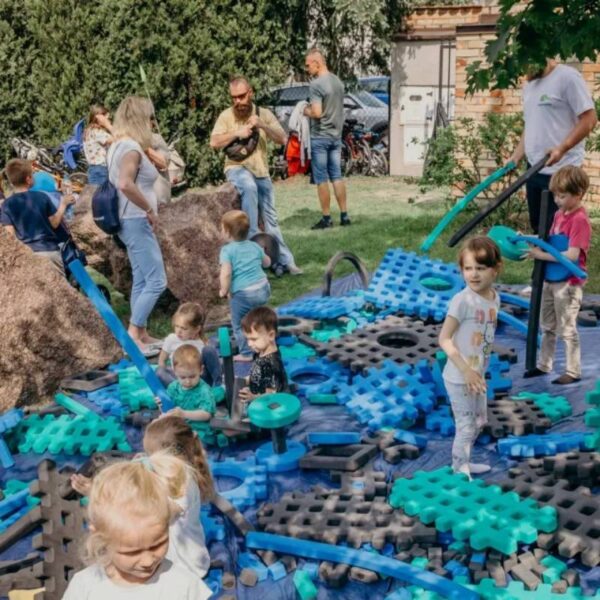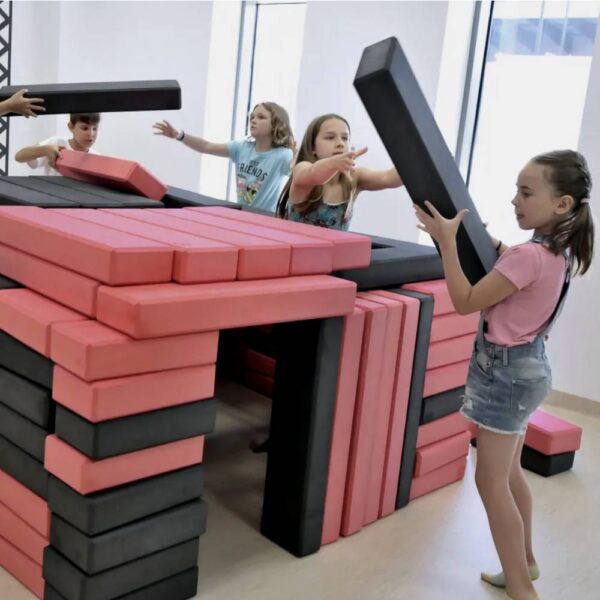
As Aleksandra Pacholik, a psychologist and therapist, writes, “Playing with Mammutico is extremely valuable for children with emotional difficulties. For withdrawn and shy children, the large blocks help them feel more confident by boosting their sense of competence. In turn, children with oppositional behavior can safely release their energy using the foam blocks, which are soft and quiet”
Mammutico in “Przylądek”
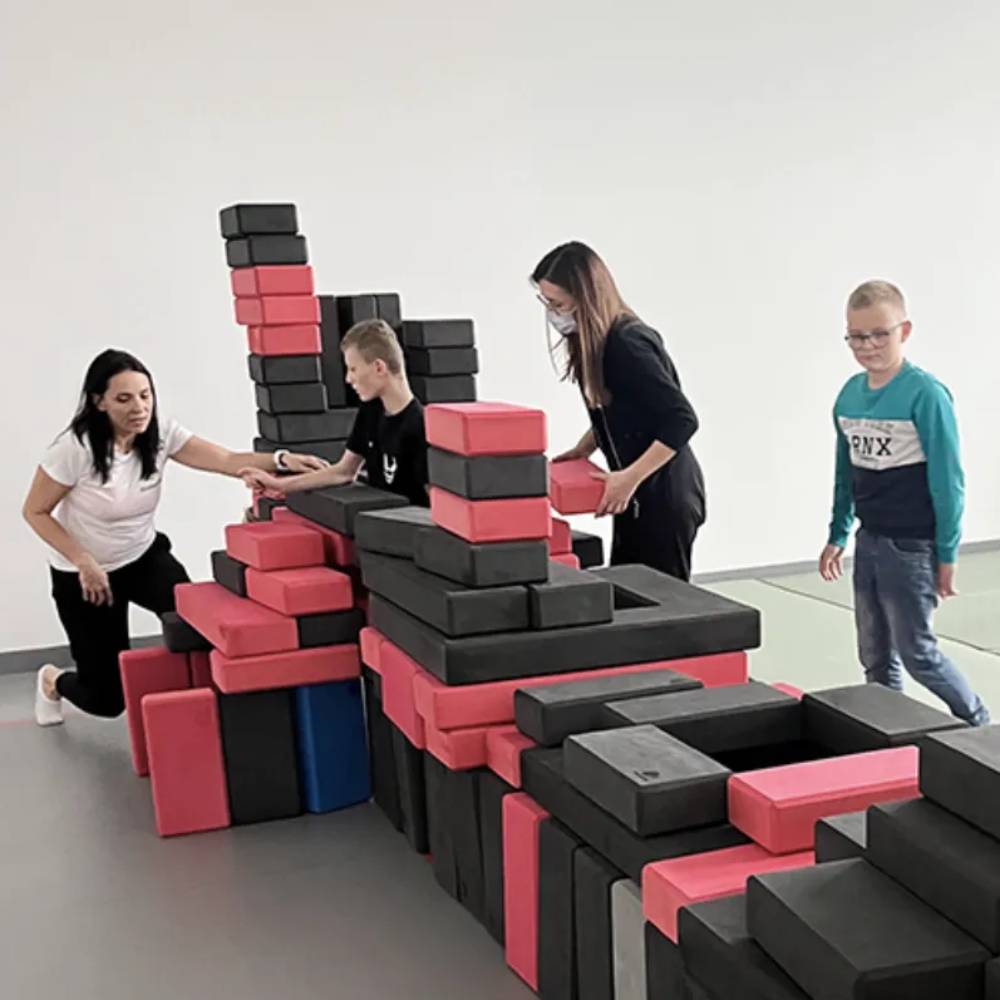
Emotional difficulties and oppositional behaviors are, among other things, traits commonly found among children on the autism spectrum. To test in practice how well our blocks would work with such a group, we asked for help from teachers and psychologists at “Przylądek,” a private elementary school in Pruszków for children with autism spectrum disorders. For several weeks, students at this school had the opportunity to use our largest set of SIMPLE blocks. We received a great deal of very positive feedback. Each child used the blocks to meet their own needs. Some children needed to burn off energy, others needed to focus on following a plan, and still others were eager to collaborate.
Here is a review from one of the teachers at the Przylądek school, who worked with the group daily during sessions with the Mammutico blocks.
Mammutico blocks are an excellent tool for working with children with autism spectrum disorders.
Justyna Pawłowska
Psychologist/Special Education Teacher. She has been working as a teacher at the Przylądek Special Education School for children with autism spectrum disorders for 10 years
Thank you for your cooperation:
“Mammutico blocks are an excellent tool for working with children with autism spectrum disorders. They prove effective across many aspects of the tasks performed, making them a versatile aid for both play and learning.
First, it’s worth noting that Mammutico blocks are simply appealing—to all children, not just those with autism. The large, unique pieces evoke positive emotions, which sets a good tone for any activity they’re used in.
When working with an autistic child, we rely on concrete objects so that the child can manipulate them. Mammutico blocks, thanks to their size, allow for the building of massive structures. The large size of the pieces makes building very easy, so even children who have trouble with motor coordination can easily build the simplest tower. The fact that the structure being built can be larger than its creator is an added bonus that encourages action and provides great satisfaction.
Large bricks, windows, and pillars allow for the creation of excellent obstacle courses tailored to children’s abilities. Children participate in creating the obstacles and then navigate them. This helps them develop physical fitness, bilateral coordination, as well as spatial awareness and planning. Additionally, the blocks help regulate muscle tone, and handling multiple pieces also stimulates proprioception.
Children on the autism spectrum often experience a condition called tactile hypersensitivity, in which even the gentlest tactile stimuli cause excessive emotional reactions or distraction. The material used to make the blocks is very pleasant to the touch. This makes it possible for children with tactile defensiveness to play with them—and even want to do so. It is worth noting here that all the pieces are also very safe; they have no sharp edges or grooves that could cut the skin. This is an extremely important aspect when working with children with various challenges, both physical and emotional.
Autism spectrum disorders are often perceived through the lens of a complete lack of interest in other people and withdrawal from social interactions. Nevertheless, through the repeated practice of simple social behaviors, we can present the child with models and safe strategies for appropriate behavior that will serve as examples to follow, and later as a foundation for modification and application in various situations. It is therefore worthwhile for the child to internalize as many elements of appropriate behavior as possible and “practice” them in various social and group settings. Playing with large blocks is a great tool for this type of work. It allows for building relationships within the group, strengthens its integration, and fosters the ability to play together. Depending on the scenario established by the facilitator, activities with large blocks can serve as daily social skills training.”