Ańa Komorowska, author of the article and podcast “The Architect from Buford Stole a Child: The Theory of Loose Parts,” referring to Simon Nicholson’s theory, emphasizes that “if children continue to play in ready-made playgrounds where everything has been designed from A to Z, they will be passive recipients of the space prepared for them and will gradually lose their childlike creativity and ingenuity.”
What if a child designed a playground?
“The best toy is one that leaves room for a child’s imagination.” — Jolanta Papuga, SI therapist
“An architect comes and designs a playground, having a great time doing it (…). Then a builder comes and has a good time too. (…) The architect creates a vision. The contractor brings that vision to life. And then the child comes along… And there’s nothing left for them to do. Because everything has already been thought out, designed, and built. From A to Z. They left nothing for the child.”
On a finished playground, children no longer have the opportunity to either design or build the structures. So they lose a great opportunity to develop logical thinking, gross motor skills, and collaboration skills.
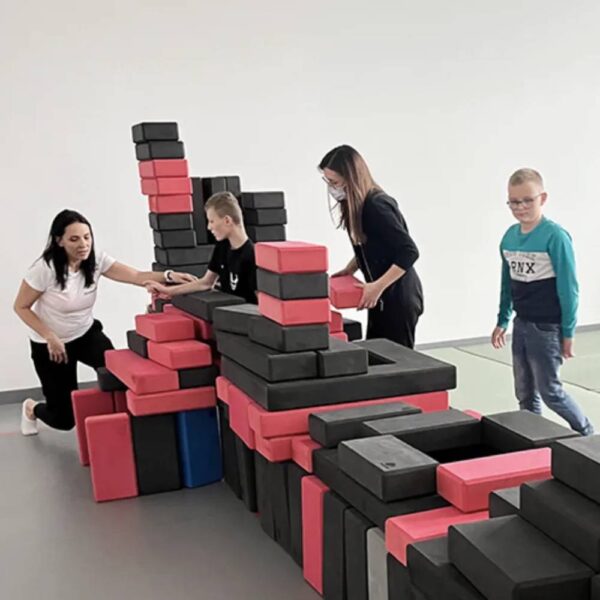
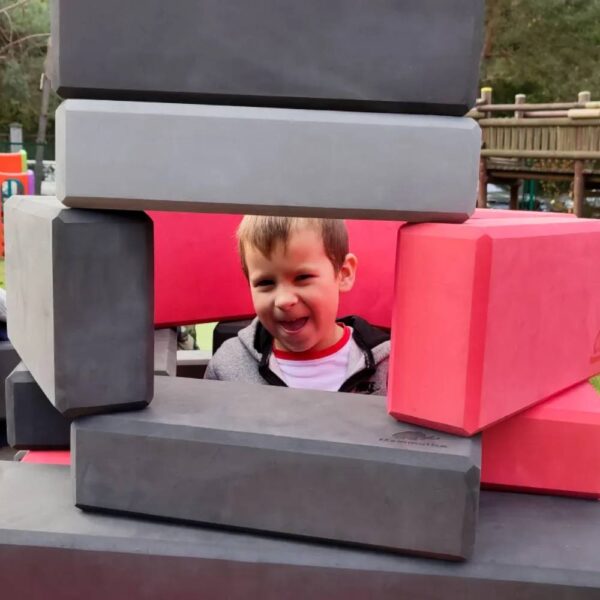
On the other hand, a playground consisting of loose parts, like Mammutico® blocks, can be taken apart and reconfigured in endless ways—it’s the best way to foster creative and innovative thinking as well as cooperation among children.
Building blocks as a tool for creation
Mammutico® blocks allow children to experiment with real-world objects. And this is the best way to learn the principles of the world around us. Children can drive a vehicle they’ve built themselves or live together in an igloo, even in a group. This is a unique opportunity that small blocks or ready-made toys simply can’t provide.
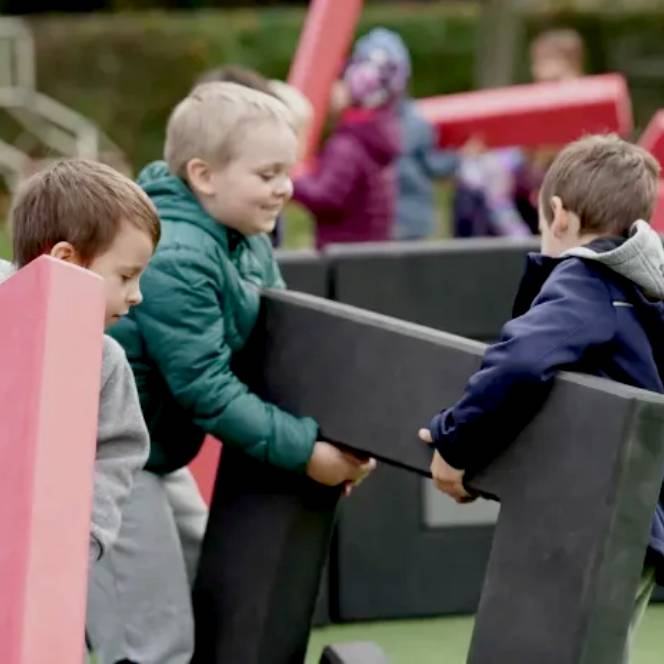
The size of the blocks, combined with their light weight and the ability to build structures larger than themselves, positively influence children’s sense of personal agency and effectiveness, which translates into increased self-esteem.
A space filled with such elements, in addition to all the benefits associated with building with blocks, also provides an appropriate amount of physical activity. Thanks to their large size, Mammutico® blocks engage the whole body, helping to develop precision, dexterity, balance, and strength. Building structures of their own design, meanwhile, supports the development of gross motor skills.
Even if you have limited space, Mammutico® blocks are the perfect solution. All it takes is a small area, and children will have a playground that sparks endless ideas. And after playtime, simply pack the blocks into convenient bags or stack them against the wall. Of course, the blocks are waterproof, so they can be used indoors and outdoors.
A playground made of loose parts is also a great solution when you have a very limited budget. A playground made of Mammutico blocks can be even several times cheaper than a ready-made playground. And at the same time, it offers enormous benefits in the form of developing children’s social, mental, and physical skills.
Mammutico® blocks are extremely durable. They withstand heavy use in preschool and daycare settings, which is crucial from the perspective of educational institutions’ budgets. It’s an investment that delivers long-term benefits.
Mammutico® blocks are waterproof and can be used outdoors, indoors, and in any season.
What does this mean?
One of the most important aspects that educational facility staff and parents pay attention to is safety. Mammutico® foam blocks are certified with a declaration of conformity, confirming that they are safe for children. They are made of Mammutico Foam®, which has been tested by Polish and international laboratories. The blocks have all necessary certifications and meet European and Polish safety standards1.
Plus, they are extremely lightweight, so even the youngest children can carry them.
Directive 2009/48/EC of the European Parliament and of the Council of June 18, 2009, on the safety of toys, as amended.
Regulation (EC) No. 1907/2006 of the European Parliament and of the Council (REACH) – Annex XVII, OJ L 396 of December 30, 2006, pp. 1–794, as amended.
PN-EN 71-1:2015-01 – Safety of toys – Part 1: Mechanical and physical properties.
PN-EN 71-2+A1:2014-06 – Safety of toys – Part 2: Flammability.
PN-EN 71-3+A1:2014-12 – Safety of toys – Part 3: Migration of certain elements.
PN-EN 71-9+A1:2008 – Safety of toys – Part 9: Organic chemical compounds – requirements.
Want to know more? Contact our educational advisors.