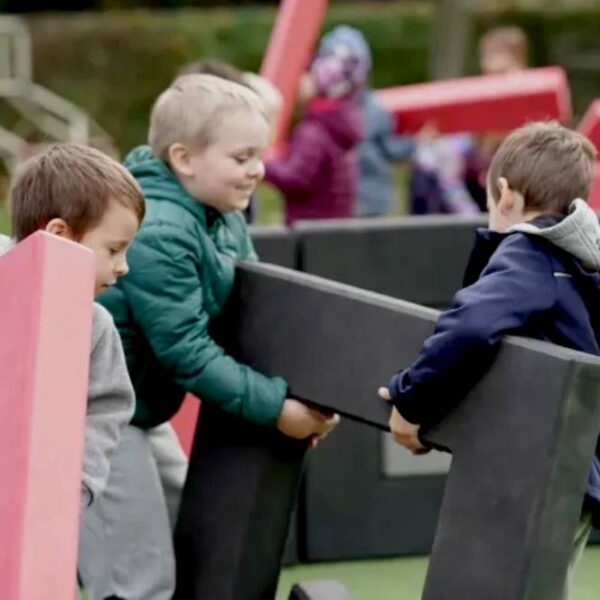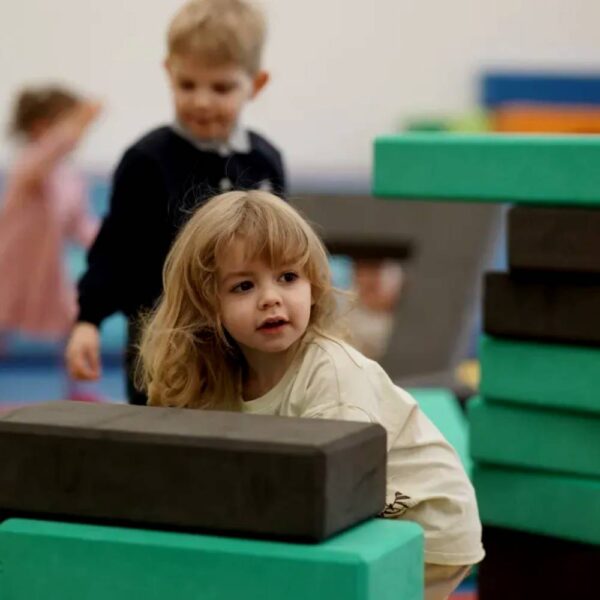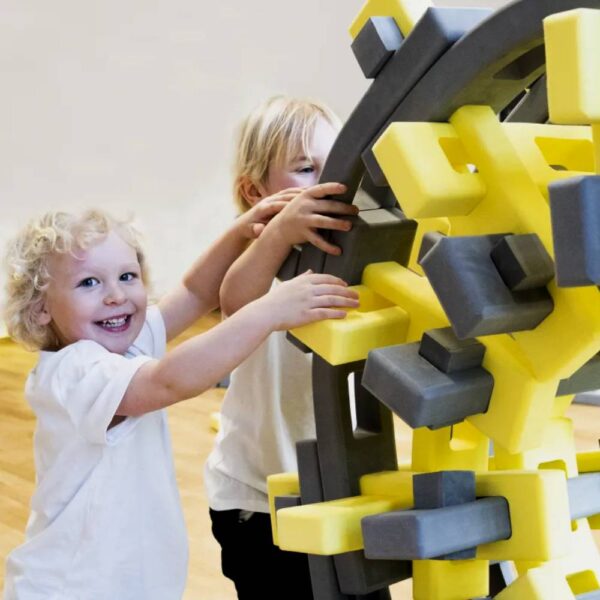
A creative playground for a preschool is available starting at approximately 50,000 PLN, while a full investment in a traditional outdoor playground often costs between 300,000 and 500,000 PLN. The difference, however, isn’t just about the budget. A traditional playground is a fixed structure. Mammutico®creates a space whose layout children design, build, and change on their own. The same elements are used for physical activity, construction play, and educational activities, including STEAM. The system can be used both outdoors and indoors, so access to the playground isn’t dependent on the weather or the season.
How much does a kindergarten playground cost?
The cost of a traditional playground goes beyond the purchase of a swing, slide, or fitness set. In addition to the price of the equipment, costs include, among other things, design, site preparation, earthwork, safe surfacing, installation, fencing, small architectural features, and supervision.
Publicly available cost estimates and information on completed projects clearly illustrate the scale of these expenses. In specific projects, the construction of new playgrounds costs from approximately 289,000 to over 500,000 PLN. The reconstruction or modernization of an existing space alone can also exceed 400,000 PLN.
The cost structure for a project with a budget of 500,000 PLN might look as follows:
- design – 15,000 PLN,
- equipment – 300,000 PLN,
- safe pavement – 45,000 PLN,
- street furniture – 30,000 PLN,
- installation and construction – 100,000 PLN,
- construction supervision – 10,000 PLN.
This means that in this example, 40% of the total budget is spent on items other than the playground equipment itself.
In the case of a Mammutico®creative playground, a budget of approximately 50,000 PLN is allocated primarily to equipment that is not permanently tied to a single location or layout.
A traditional playground also involves paperwork
A permanent playground is an investment that requires proper planning and execution. Factors such as the location of the equipment, safety zones, the type of shock-absorbing surface, site preparation, and technical requirements must be taken into account. As a general rule, building a playground also requires completing the formalities mandated by building codes.
In practice, the list includes, among other things: the design, notification of construction work, site preparation, earthwork, installation of appropriate surfacing, permanent installation of equipment, maintenance of required safety zones, final inspection and subsequent inspections, maintenance, and repairs.
Playground equipment and surfaces are also subject to safety requirements specified, among others, in the PN-EN 1176 and PN-EN 1177 standards.
Mammutico®does not require construction work or permanent installation. The system can be used on typical surfaces available at the facility—including grass, a sports field, flooring, or pavers. Outdoors, simply deliver the components to the desired location and set them up. Indoors, the playground can be set up in a room designated for permanent or regular play.
What does a creative playground offer besides physical activity?
In a traditional playground, the design and function of the equipment are predetermined. A swing is for swinging, a slide is for sliding, and a pre-built obstacle course follows the same route every time.
With Mammutico®, building is part of the fun. Children plan the structure, select elements, connect them, test the result, and make adjustments. They create obstacle courses, vehicles, structures, balance beams, mazes, and their own spatial arrangements. The next play session doesn’t have to take place in the same area—a new one can be created using the same pieces.
This approach also allows the equipment to be used during STEAM classes. Children design structures, check their stability, look for the right connections, test solutions, and correct mistakes. A single set of equipment thus combines physical activity with building, planning, collaboration, and problem-solving.
The ability to move the playground indoors is also important. Rain, frost, or low temperatures limit the use of a traditional outdoor playground. Mammutico®can be used indoors regardless of weather conditions. If the facility allocates a permanent space for it, the playground remains accessible without having to carry the components in and set them up each time.
Does a traditional playground have any advantages?
Yes, although one of its advantages depends on how the facility’s space is organized.
A permanent outdoor playground is immediately accessible—children go out to the yard and use the installed equipment. If Mammutico®is stored elsewhere and used outdoors, the components must be carried out and set up. With a dedicated indoor room, this difference practically disappears. The play area can remain set up and ready for play, and it also functions even when the weather prevents the use of outdoor equipment.
A more obvious advantage of the traditional solution is its large, permanently installed structures —tall towers, elaborate slides, and climbing structures. Mammutico®does not attempt to imitate them. It offers a different function: instead of a single, ready-made structure, children are given elements to create many different configurations.
These two solutions do not have to be mutually exclusive. If a preschool already has a traditional playground, Mammutico®expands the ways the space can be used to include building, experimenting, and educational activities, while the indoor version additionally provides a space for active play all year round. If the playground is yet to be built, it’s worth comparing the cost of the entire project with equipment that isn’t permanently tied to a single location or function.
Traditional or Creative Playground? A Comparison
| Criterion | Traditional playground | Mammutico®Creative Playground |
| Cost | The total investment often ranges from 300,000 to 500,000 PLN | A set starts at approx. 50,000 PLN |
| What the budget covers | Equipment and design, site preparation, surfacing, installation, and other infrastructure | Primarily equipment |
| Paperwork | Design and paperwork related to the project’s implementation | Excluding construction work and permanent installation |
| Subgrade | Surface selected to accommodate the equipment and required safety zones | Grass, sports field, flooring, pavers, and other surfaces suitable for children’s activities |
| Location of use | Primarily a permanent outdoor location | Outdoors or indoors |
| Weather Dependency | Rain, frost, and low temperatures limit usability | Indoors, available regardless of weather or season |
| Ready for use | Permanent equipment is ready as soon as you step outside | Outdoors, the components must be carried out and set up; in a dedicated room, the play area can remain ready for play |
| How to Use | Permanent equipment with specific functions | The layout is created and reconfigured during play |
| The child’s role | User of the ready-made infrastructure | User, designer, and builder |
| Changing the layout | Requires rearranging, moving, or replacing equipment | Components are used to create new configurations |
| Mobility | Equipment tied to a specific location | Equipment moved between spaces |
| Physical activity | Yes | Yes |
| Construction play | Limited by the design of the equipment | One of the system’s core functions |
| STEAM | Dependent on additional activities and equipment | Classes conducted using the same system |
| Large permanent structures | Yes—including tall towers, slides, and climbing structures | No—the system is based on modular structures |
| Expansion | Purchase and installation of additional equipment, and sometimes additional work | Purchase of compatible components or sets |
| Changing the function of the space | Limited by fixed infrastructure | Once the components are assembled, the space can be repurposed for other activities |
| Maintenance | Inspections, maintenance, and repairs of permanent equipment and infrastructure | Cleaning, condition checks, and storage of components |
What to Choose for a Preschool?
If your priority is permanent outdoor infrastructure with large, permanently installed equipment, a traditional playground serves this purpose.
If a lower investment threshold, year-round use, mobility, flexibility in design, and the combination of physical activity with building and learning are important, a creative playground is worth considering.
The difference is fundamental: a traditional playground offers children a ready-made structure and predetermined ways to use it. Mammutico®allows them to create the playground from scratch—changing its layout, function, and how they play.