Many of our clients are educational institutions where psychologists and educators work. Most specialists are happy to share their opinions with us about their students playing with large blocks Mammutico. Today, we present to you a review of our largest SIMPLE set in the context of the theory of loose materials.
Loose parts – why they’re so important
The theory of loose parts was first formulated by architect Simon Nicholson, who emphasized that:
in any environment, both the degree of inventiveness and creativity, as well as the opportunity for discovery, are directly proportional to the number and type of variables within it.
As Ana Komorowska, author of the article and podcast “The Architect from Buford Stole a Child. The Theory of Loose Parts,” explains on her blog, this means, more or less, that:
if children continue to play in ready-made playgrounds where everything has been designed from A to Z, they will be passive recipients of the space prepared for them and will gradually lose their childlike creativity and ingenuity.
The author then gives an example of playground design:
An architect comes along and designs a playground, having a great time doing it (…). Then a builder comes along and has a good time too. (…) The architect creates a vision. The contractor brings that vision to life. And then a child comes along… And there’s nothing left for them to do. Because everything has already been conceived, designed, and built. From A to Z. They left nothing for the child.
The Theory of Loose Parts and the “Mammutico” foam block set
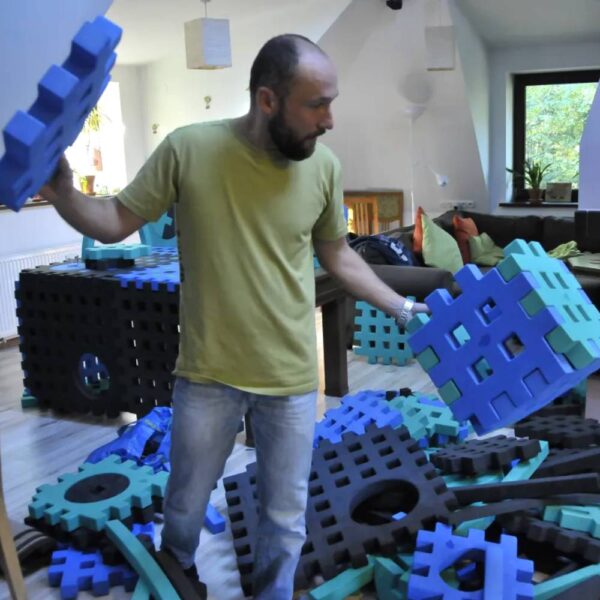
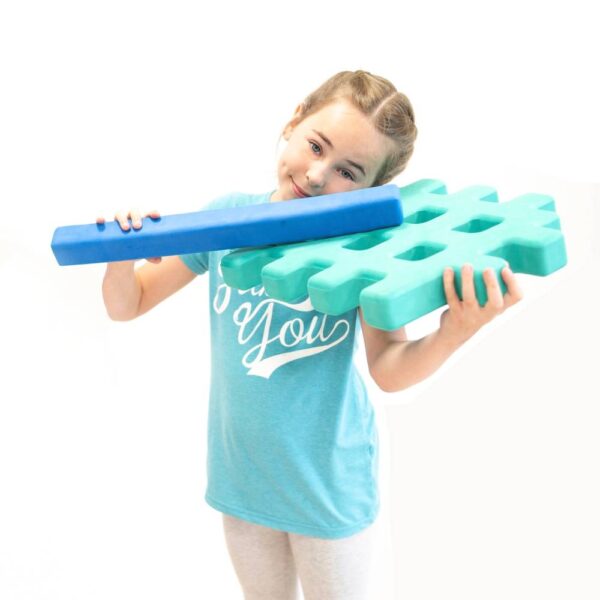
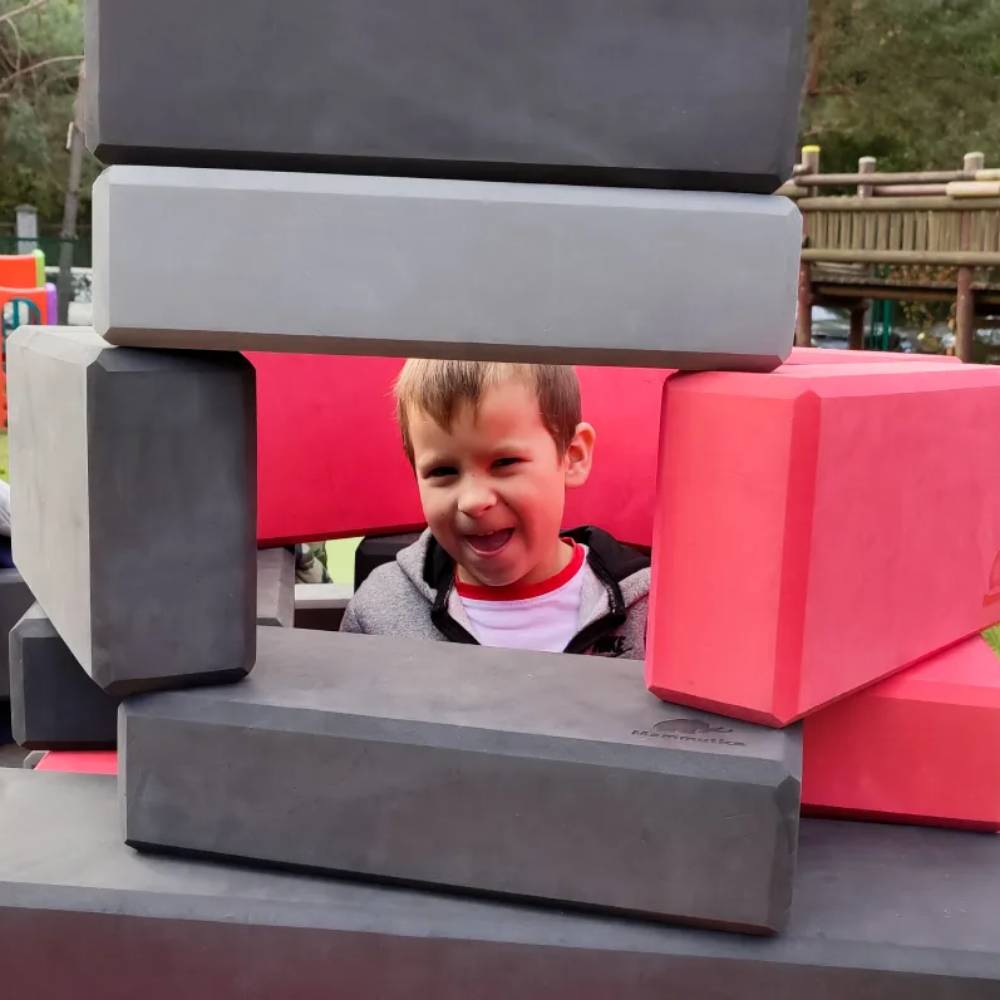
What does the “Theory of Loose Parts” have to do with the giant SIMPLE blocks? Looking at the set’s components, the answer is obvious. Children have only 3 different shapes of the same size at their disposal, and the blocks do not connect to each other in any way. And it is precisely these features that make playing with such a set leave plenty of room for imagination!
With a space equipped solely with a set of simple foam blocks, users can build whatever they feel like at the moment. By visiting the same place every day, they can change and adapt its appearance each time to match their current mood and the friends they’re playing with.
A space filled with such elements, in addition to all the benefits associated with building with blocks, also provides a good dose of physical activity. Even stacking one block on top of another requires activity that engages almost the entire body. Thus, a space with large blocks also fulfills one of the basic functions of a playground: a place where children can run around.
Loose elements—the main feature of SIMPLE large blocks
As emphasized by a teacher at a private preschool where children have been playing with Mammutico blocks for several years, the elements of the SIMPLE set provide vast scope for fostering imagination and reinforce a sense of accomplishment. You can learn more about one of our largest and simplest sets from the review below. It was based on a statement by an expert. We also invite you to watch it.
Małgorzata Stępniak – Deputy Director and Educator at the “Jedynka” Preschool, Local Education Center in Pruszków:
A preschool is a place where building blocks are part of everyday life. Children always play with blocks and have always played with blocks. At the preschool where I work, we have the special pleasure of using “Mammutico” blocks (the large SIMPLE set), and we truly see the great value of playing with these types of blocks every day.
At our facility, we’ve used these blocks both in the classroom and on the playground, and they’ve worked wonderfully in both settings. Despite having just three simple shapes, the kids really do all sorts of things with them. In addition to having fun, we also observed plenty of educational benefits, lots of joy, and mutual interaction. The benefits of playing with large blocks include, of course, creativity and the stimulation of spatial imagination, but also learning cooperation and communication.
The blocks were a Children’s Day gift, and our expectations were that, first, they would bring joy, and second, they would bring younger children and preschoolers together through play. Everything worked out perfectly.
SIMPLE blocks are seemingly unrelated to one another. We usually perceive blocks as parts that can be connected, but in this case, we are dealing with loose elements that are independent of one another. This feature is of immense value; it provides a vast field for shaping the imagination—both spatial and internal. Moreover, this kind of play gives a sense of success; there’s no chance of failure here—you can always build something from these loose pieces. You can change things, add pieces, rearrange them—it’s always interesting. Precisely because these parts aren’t connected to each other, the blocks simply never get boring.