
The issue of peer violence stirs up a great deal of emotion today. We often don’t start looking for solutions until the problem at school becomes urgent. Meanwhile—as Maria Berlińska, a longtime expert in prevention, a trainer of parenting skills workshops, and the author of the book *Mom, Dad, You Don’t Have to Be Perfect*, emphasizes in a conversation with Dominik Berliński —the foundations of safe relationships are laid from a child’s earliest years, and the attitudes of adults and the thoughtful organization of play spaces play a key role here.
We invite you to read the summary of the webinar “Preventing Peer Violence,” which took place as part of our “Project: Playground” series.
Where Do the Roots Lie? Temperament, Bonding, and Avoiding Labels
A child is not born a “perpetrator” or a “victim,” but comes into the world with a specific temperament. We cannot change their innate liveliness or shyness—our task is to help them cope with the challenges these traits bring. A hyperactive child needs support in calming down, while a withdrawn child needs gentle encouragement to venture more boldly into the world.
According to many years of research, the most important factor protecting a child from risky behavior and violence is a strong, healthy, love-based emotional bond with their parents. Equally important is how adults—parents and teachers—respond to the first conflicts that arise in daycare or preschool.
The most common mistake adults make is judging and blaming (“How could you do that?”, “It’s you again!”). Such messages do not teach a child how to manage their emotions but instead instill in them the belief that they are “hopeless” or “bad,” which only intensifies anger and reinforces undesirable roles within the group.
The rule for intervening in conflicts between children: We always immediately stop physical violence so that no one gets hurt. First and foremost, however, we attend to the child who has been harmed, without attacking the “perpetrator.” This approach may seem surprising, but it allows us, on the one hand, to address the upset child’s emotions, and on the other, to give the aggressor space to reflect on what happened. We only have a corrective conversation with the children once both parties have calmed down—without passing judgment, but with a clear reminder of the group’s rules.
Fear always lies beneath aggression
Children who hit, push, or exclude others are rarely self-confident. In reality , fear always lies at the root of aggression—in both children and adults. Aggressive behavior is often the only way a child knows how to cope with tension, a lack of acceptance, or a feeling of not being understood.
This is clearly illustrated by the following examples:
- Children in daycare: Separation from their primary caregiver before the age of 3 is extremely stressful for a toddler. Biting or pushing at daycare (even if the child is completely calm at home) is a sign of emotional overload. Such a child requires firm intervention to stop the difficult behavior, but at the same time needs a great deal of tenderness, hugs, and acceptance—both at daycare and upon returning home.
- Children from more challenging backgrounds: They often start school with a smaller vocabulary and social deficits. Unable to understand their peers or the teacher’s instructions, they quickly find themselves on the margins of the class. Rejection breeds frustration and anger, which can easily turn into violent behavior. Here, too, the most important thing is the support of teachers—their understanding and help in enabling these children to catch up with their peers—rather than blaming them and reinforcing their role as “inferior.”
Independent Thinking and Cooperation with Parents
Instead of doing the work for children in resolving conflicts and imposing ready-made scenarios on them (“Apologize immediately”), it’s better to teach them to think for themselves and take responsibility. Questions such as: “What happened?”, “How do you think your classmate felt?”, “What can you do now to make it right?” —help develop empathy and a sense of agency.
In the school environment, a partnership between teachers and parents is also crucial. The school cannot tackle violence (especially when it spills over into the online world outside of school hours) on its own. As early as the first parent-teacher meeting, it’s a good idea to work out a joint agreement with parents and establish rules for responding to difficult situations. It’s also a good idea to have the children help develop this joint agreement during homeroom, as well as to establish rules for reporting situations where the agreement is violated. It’s also important to teach children to distinguish between ordinary “tattling” and reporting a serious problem that threatens someone’s safety or mental health.
And I’d like to see this presented in a neat little box:
What is the difference between ordinary “tattling” and reporting a serious problem?
The difference between ordinary “tattling” and reporting a serious problem boils down primarily to four aspects: the child’s intention, the severity of the threat, whether the child is able to handle the situation on their own, and the way the child communicates the problem.
The rule “we don’t tattle” is often repeated at school or at home, but children themselves can’t always tell where trivial nitpicking ends and a matter requiring adult intervention begins.
To help children (and adults) distinguish between these two situations, it’s helpful to rely on four key criteria:
| Criterion | Ordinary “tattling” | Reporting a serious problem |
|---|---|---|
| Intention (Why am I doing this?) | A desire to harm a classmate, make them look bad, cause them to be punished, or gain an advantage in the eyes of an adult. | Concern for oneself or another person; the need to stop harm, get help, and restore safety. |
| Scale and consequences | Minor misbehavior or breaking insignificant rules that don’t pose a real threat to anyone ( e.g ., “He said a bad word, ” “She colored it wrong”). | Situations that threaten physical health or life, as well as mental health —e.g., physical abuse, exclusion from a group, bullying, online hate, or the perpetrator forcing the child to keep a secret. |
| The Child’s Agency | A situation the child can handle on their own (e.g., walking away, setting a boundary verbally, or talking to a peer). | A situation that is beyond the child’s capabilities—an imbalance of power, repeated violence, or the other party’s failure to respond to a request to stop. |
| Nature of the Message | Focusing on the guilt of a specific person and expecting an adult to punish them. | Describing the difficulty as a phenomenon or a need (e.g. , “There’s a problem in our class because someone is being hurt” or “I’m worried about a classmate”). |
How can we explain this difference to children?
- The “Health and Safety” principle (including mental health): even if someone has made a child promise to keep a secret, that secret no longer applies the moment someone is being harmed. It’s important to make it clear to children that health isn’t just the absence of bruises, but also a sense of safety and peace of mind—prolonged teasing, mocking, or isolation can harm a child’s mental well-being just as seriously as physical violence.
- The “Do I Want to Help or Punish?” Test: A good follow-up question to ask a child is: “Are you telling me this to help someone and keep everyone safe, or so that I can punish someone?”
- Encouraging Independence with Minor Issues: When a child comes with a minor complaint (e.g. , “He said he doesn’t care about you”), the adult should avoid falling into the trap of judging or dismissing the child’s emotions (“You’re having a problem again”). Instead, they can ask: “I can see that this upset you. What can you tell him yourself so he knows you don’t like that?” or “If he has something to say to me, tell him I’d be happy to talk to him.”
Making this distinction removes the stigma of being a “tattletale” from children and gives them clear permission to seek help from adults whenever a situation gets out of hand.
How do space and creative play reduce aggression?
In violence prevention, the environment in which children spend their time is of immense importance. Traditional playgrounds or rooms filled exclusively with pre-selected toys often limit children’s self-expression, while monotony and a lack of space for collaboration breed frustration and competition (e.g., fighting over a single swing or dominance in a team game).
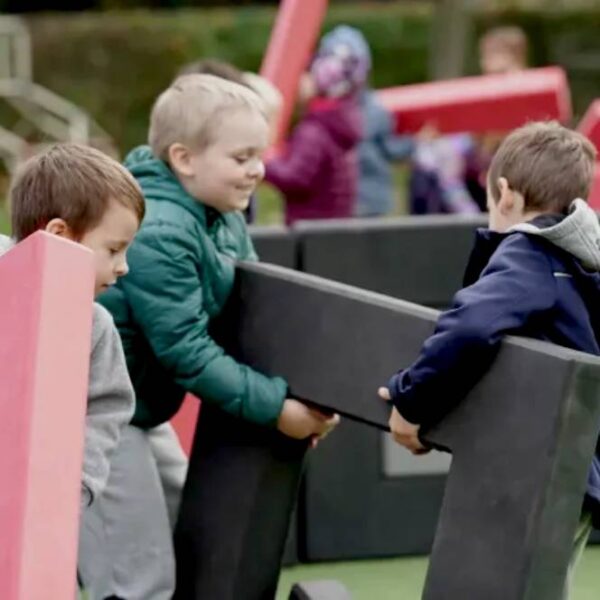
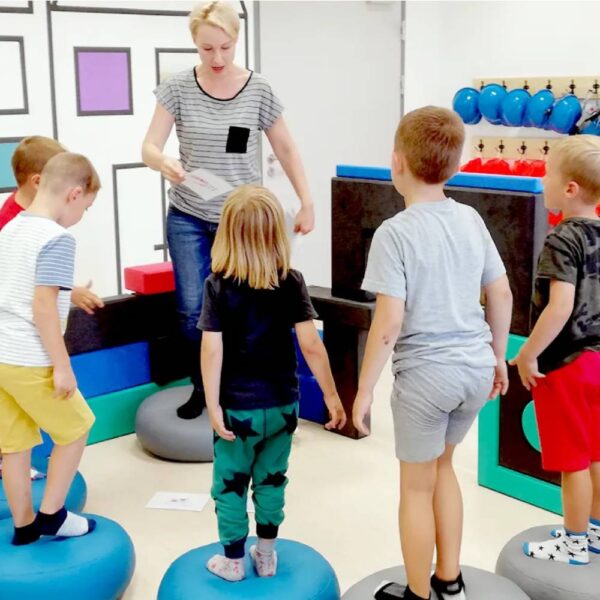
The concept of a creative space based on“loose parts,” such as large-format Mammutico blocks, works quite differently. Why do these types of tools support violence prevention?
- They relieve tension and provide an outlet for emotions: The ability to freely create, build, and transform one’s own reality has a calming effect and allows children to safely release pent-up anger.
- They teach communication and cooperation: Large-format elements encourage collaborative work within a group. Children must talk to one another, negotiate ideas, and share tasks—and it is precisely within a peer group that they best learn constructive communication.
- They build a sense of success without competition: In open-ended play, there is no single “correct” end result. Loose elements will always result in something interesting, which gives children a sense of agency and success—especially important for shy children or those who often experience failure in traditional education.
- It provides space for observation: Free, creative play is the best mirror of group dynamics for teachers and caregivers. It allows you to quickly identify children who are withdrawn, who need support in making connections, and those who try to dominate—and to gently, without judgment, help them find balance.
Do you want to create a space in your facility that fosters cooperation, calms emotions, and helps build safe relationships among children? Discover the large-format blocks Mammutico and see how these loose-fitting pieces can transform everyday play at daycare centers, preschools, and schools.
Where can schools find content and training support?
Educational institutions don’t have to tackle peer violence on their own. If you want to train your teaching staff, organize workshops for students, or implement systemic solutions at your school, take advantage of these proven resources:
| Nationwide systemic programs: The Dajemy Dzieciom Siłę Foundation (FDDS) and the“RÓWIEŚNICY” program—a free prevention program for elementary and secondary schools aimed at combating peer violence. The RESQL Project (SWPS University)—a modern system for responding to violence, featuring an app for anonymous reporting and training for staff. NASK (Safer Internet) and the “Cyberprofilaktyka” program—webinars, guides, lesson plans, and materials on cyberbullying and online hate speech. Workshops and interventions in schools: “Bliżej Dziecka” Association – training for teachers, crisis interventions, and self-confidence training for children. STOP-KLATKA Association of Drama Practitioners – workshops for students and staff based on the drama method and Nonviolent Communication (including the “Giraffe Calm” program). Free public support and funding: Regional Psychological and Pedagogical Counseling Centers (PPP) and the Center for Educational Development (ORE) —free consultations, crisis interventions, and methodological materials. Municipal Alcohol Problem Resolution Committees—as Maria Berlińska noted during the webinar, local governments have funds allocated for prevention (the so-called “alcohol fund”), which schools can use to pay for external trainers and psychologists. |